


Introduction: Water Quality Threatens Geothermal Efficiency
Across the world, geothermal heat pumps offer a sustainable alternative to traditional fossil fuel-sourced heating. Yet in approximately 30% of Swiss regions, hard water coupled with unfavorable mineral conditions creates a persistent problem: geothermal systems gradually lose efficiency due to calcification, corrosion, and bacterial colonization. Without intervention, these conditions force expensive maintenance cycles and operation interruptions that undermine the economic case for renewable energy. RELL AG, a facility in the town of Susten, faced exactly this challenge—and implemented a solution worth documenting.
The Challenge: Three Heat Exchangers Under Threat
The RELL AG facility operates three plate-type heat exchangers for its geothermal system. Prior to AQUA4D installation, these exchangers faced mounting operational stress from two primary sources: calcification and bacterial colonization.
According to the installation report, the system was designed to prevent two specific threats. First, the accumulation of sludge and deposits in the piping network, pump, and heat exchangers—which accumulates over time and restricts flow. Second, the proliferation of iron bacteria, specifically Gallionella and Leptothrix, which thrive in groundwater and cause oxidation of dissolved iron, leading to biofilm formation.
The control tube photographs reveal the scope of this challenge: the piping network showed severe contamination at the point of installation, with heavy mineral and bacterial deposits visibly coating the internal surfaces:
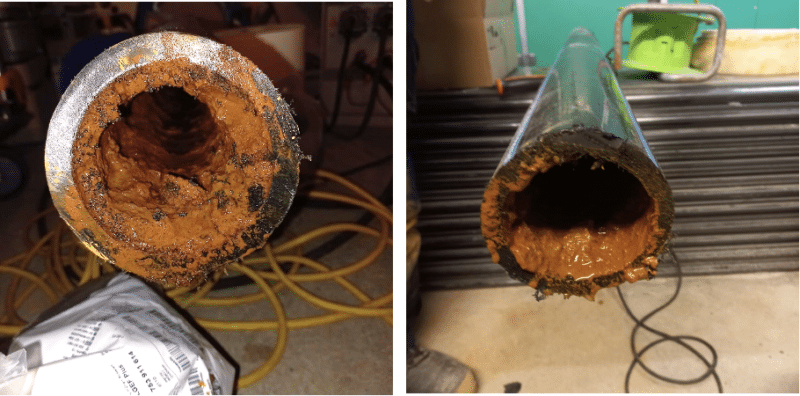
Cross-section of a ‘monitoring tube’, used by AQUA4D to gain insights without needing to remove whole piping
The Solution: Physical Water Treatment at Source
AQUA4D® physical water treatment was installed at the point of capture, positioned near the pump and upstream of the three plate-type heat exchangers. The purpose, according to the installation report, is to prevent calcification, corrosion, and bacterial proliferation throughout the system.
Unlike chemical additives or mechanical filtration, AQUA4D operates through physical modification of water structure. The system does not alter the chemical composition of the water and does not require ongoing chemical inputs, a critical advantage in geothermal applications where groundwater re-injection is required and chemical contamination must be avoided.
Beyond visual inspection, efficiency is monitored continuously by tracking flow rates and water pressure upstream and downstream of the three plate heat exchangers. This dual approach – visual control tube inspection combined with flow and pressure monitoring – provides a comprehensive picture of system performance over the 9-month reporting period.
Results: Visual Transformation Documented Over Nine Months
The control tube inspections provide visual proof of the system’s effectiveness. By December (two months later), initial inspections showed deposits beginning to soften and break down. By March, five months into operation, the transformation became measurable: flow rates had noticeably improved, and the original pipe material—previously hidden beneath deposits—was becoming visible again. By the following October , one year after installation, the control tube inspection documented the reversal: heavily corroded surfaces had been replaced by clean pipe walls with only minor residual deposits remaining. Most significantly, a protective passivation layer had formed on the pipe surfaces, preventing new corrosion from taking hold. The report’s photographs document this progression from fouled to clean, demonstrating not merely symptom management but actual system restoration.
Markus Schwery, who oversaw the project, observes: “When looking at the condition of the piping at installation, in can be stated that this is a very good result. Not only was the massive encrustation broken down, but new sludging was prevented. Furthermore, through regular flushing of sludge from the pipelines, flow rate is continuously increased and new deposits in both the pipelines as well as in the plate heat exchangers are prevented. The graph shows that the flow rate could be increased by 40% within a short time.”
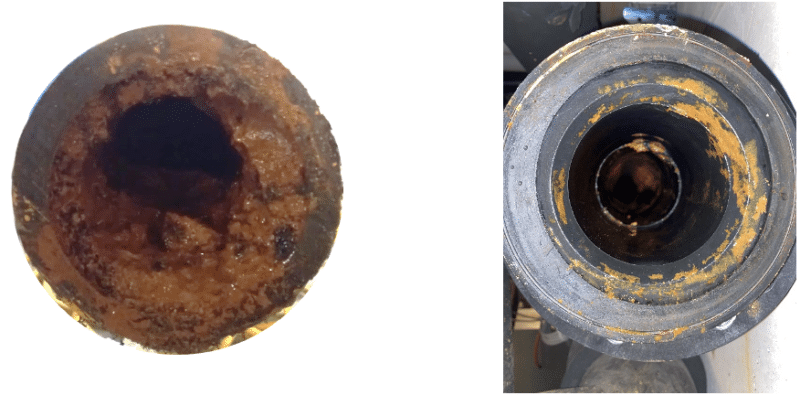
Left: upon installation, October 2024. Right: inspection in October 2025
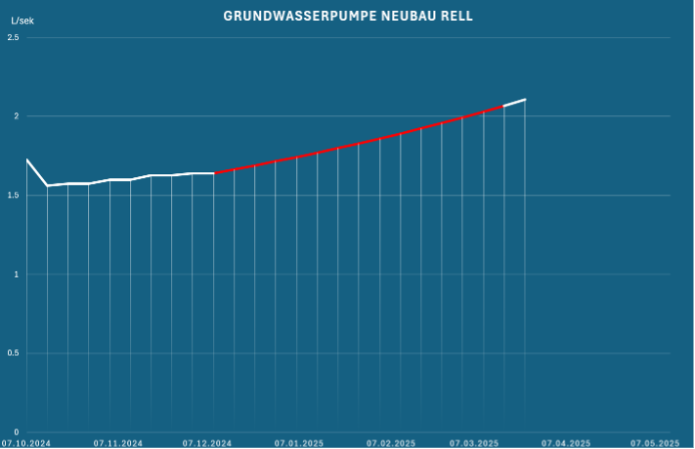
“We took another measurement today. The system has shown positive progress. The flow rate has increased by about 40 percent.”
– Manuel Schnyder, RELL AG, 6 months after installation
Results: Visual Transformation Documented Over Nine Months
The control tube inspections provide visual proof of the system’s effectiveness. By December (two months later), initial inspections showed deposits beginning to soften and break down. By March, five months into operation, the transformation became measurable: flow rates had noticeably improved, and the original pipe material—previously hidden beneath deposits—was becoming visible again. By the following October , one year after installation, the control tube inspection documented the reversal: heavily corroded surfaces had been replaced by clean pipe walls with only minor residual deposits remaining. Most significantly, a protective passivation layer had formed on the pipe surfaces, preventing new corrosion from taking hold. The report’s photographs document this progression from fouled to clean, demonstrating not merely symptom management but actual system restoration.
Markus Schwery, who oversaw the project, observes: “When looking at the condition of the piping at installation, in can be stated that this is a very good result. Not only was the massive encrustation broken down, but new sludging was prevented. Furthermore, through regular flushing of sludge from the pipelines, flow rate is continuously increased and new deposits in both the pipelines as well as in the plate heat exchangers are prevented. The graph shows that the flow rate could be increased by 40% within a short time.”
Broader Context: Geothermal Challenges and Success Stories
RELL AG is not alone in facing geothermal efficiency challenges. The installation report notes that hard water and unfavorable mineral conditions prevent reliable near-surface geothermal energy use in up to one-third of Switzerland. Three high-profile geothermal installations offer relevant context for RELL AG’s experience.
1. FANUC (Industrial Facility):
At FANUC Switzerland, a manufacturing facility operating a groundwater heat pump faced recurring iron bacteria colonization. Multiple cleaning approaches—chemical treatment, high-pressure water jets, and mechanical cleaning—proved only temporarily effective. The facility required complete heat exchanger disassembly and cleaning several times per year. After installing AQUA4D treatment units in the groundwater supply line, the situation reversed dramatically. Within 18 months of operation, no additional maintenance calls were needed, and when the heat exchangers were finally inspected again, they were cleaner than when initially installed, with surfaces shining. The facility now operates 365 days per year without problems.
2. Brigerbad (Residential Facility)
Brigerbad, a new residential building in Valais equipped with geothermal heating and cooling, encountered system blockages from iron bacteria shortly after installation, forcing temporary replacement by an energy-intensive electric boiler. After AQUA4D installation in January 2022, data showed stable outgoing water temperatures at 47 degrees over three-month periods, indicating restored system stability.
3. KUSPO/Lenk (Municipal Sports Facility)
As a municipal sports facility in continuous use requiring year-round constant temperatures, Kurs und Sport Zentrum (KUSPO) in Lenk faced mandatory heat exchanger cleaning every 4-6 weeks at a cost of 4,000 CHF per cleaning cycle, causing operational disruptions. After AQUA4D installation, the cleaning threshold was no longer reached. Since installation, the heat exchanger has never required cleaning again – described by the consulting engineer as a complete success and bringing a Return on Investment in a remarkably short time.
4. Aeschbach Chocolatier (Swiss Production Facility)
The plate heat exchangers at this chocolate producer revealed heavy “reddish sludge” caused by iron bacteria, needing regular (and costly) professional cleaning. Within months of installing AQUA4D, results were evident: technicians found markedly reduced sludge deposits, lighter discoloration, and one exchanger with so little fouling it could remain closed. Maintenance contractors accustomed to high-pressure cleaning work immediately noticed the difference. Aeschbach estimates the investment will pay for itself in less than two years if cleaning frequency is merely halved, and potentially within one year at current performance rates.
Conclusion: A Brighter Geothermal Future
These installations across Switzerland demonstrate that calcification and bacterial colonization are no longer unsolvable or costly problems. By treating water at the source through physical means – without chemicals, additives, or complex maintenance – geothermal facilities can avoid the degradation cycle that typically forces cleaning cycles and operation interruptions.
For Switzerland, where approximately 30% of regions face hard-water conditions unsuitable for geothermal operation, this approach offers a pathway to broader adoption of sustainable heat pump technology. There is now abundant real-world evidence that water treatment at the geothermal system intake can restore and maintain efficiency for years, turning a hidden technical constraint into a solved problem.
Interview with Pärli AG, installers of the AQUA4D system at FANUC in Switzerland
Switzerland
Sustainable Buildings
Heat Pumps
“When looking at the condition of the piping at installation, in can be stated that this is a very good result. Not only was the massive encrustation broken down, but new sludging was prevented. Flow rate is continuously increased and new deposits in both the pipelines as well as in the plate heat exchangers are prevented; the flow rate could be increased by 40% within a short time.”
– Markus Schwery, Project Leader