


A leading arboretum in Urla, Turkey conducted a rigorous trial that proves physical water treatment works – even on water most growers consider unusable.
UZBAŞ Arboretum operates a 200-hectare ornamental plant nursery in Urla, İzmir, Turkey. Founded in 1996, the facility is one of the region’s largest producers of Mediterranean palms, tropical and subtropical outdoor plants, and specialty ornamentals – managing over 250,000 palm trees across 52 species and 1,900 total plant varieties.
Like many growers in Turkey’s coastal regions, UZBAŞ operates with well water characterized by extreme hardness. In fact, their primary water source tested at 43.5°F hardness (435.79 mg/L CaCO₃), placing it in the top 5% hardest irrigation water sources in agricultural use globally. This extreme hardness creates constant challenges: mineral scaling in irrigation lines, reduced water flow, compromised nutrient availability for plants, and high operational costs.
Faced with such issues, UZBAŞ looked into whether AQUA4D® physical water treatment technology could enable them to reduce irrigation while maintaining plant quality on such challenging water?
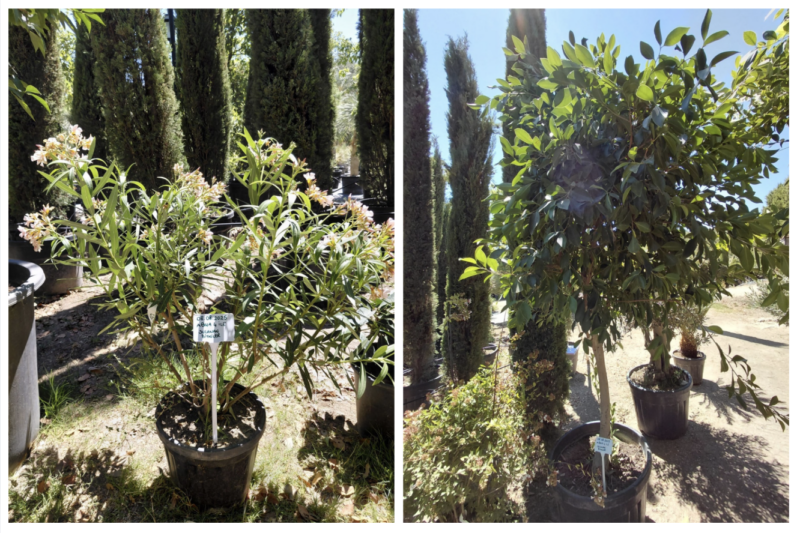
Labelled trees as part of the AQUA4D trial at Uzbas Arboretum
The Trial Design
In July 2025, UZBAŞ and their AQUA4D® supplier conducted a collaborative trial using three treatment groups grown under identical conditions with the facility’s actual well water:
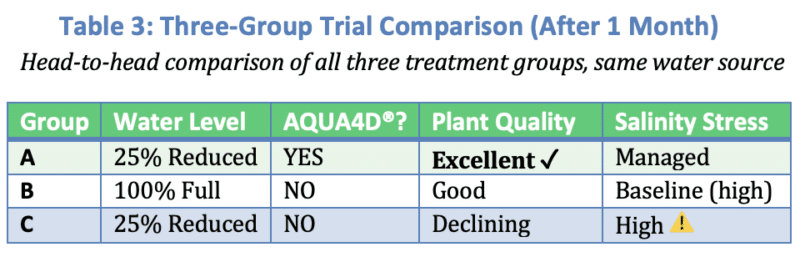
Group A received 25% reduced irrigation combined with AQUA4D® treatment. Group B received full irrigation without the system. Group C received 25% reduced irrigation without AQUA4D®.
The trial measured soil chemistry and plant nutrient content across 10 different ornamental plant species. Laboratory analysis included 30 soil analyses and 30 leaf analyses (60 total) measuring nutrient parameters, salinity levels, and water quality metrics. Data analysis employed AI-based methodology to assess practical significance across the results.
Water Quality: 43.5°F Hardness
The water UZBAŞ works with daily presents one of the region’s most challenging irrigation scenarios. Analysis by agriOlaben Laboratory (Turkish Standards certified) in May 2026 showed:
- – pH: 7.3 (neutral)
- – Electrical Conductivity: 1,065 µS/cm (very high mineral content)
- – Total Hardness: 435.79 mg/L CaCO₃ (43.5°F)
- – Calcium: 5.90 me/L (high—primary hardness cause)
- – Magnesium: 2.86 me/L (very high—secondary hardness cause)
For context, water is classified as “extremely hard” above 40°F. This level of hardness typically forces growers into two choices: invest in expensive reverse osmosis systems ($50,000-200,000+ capital cost plus $30,000-50,000 annually in energy) or accept compromised production and high input costs.
The Results
After one month of the trial, the data already showed clear differences between the three groups.
When plants received 25% less water without AQUA4D® (Group C), performance declined as expected. Facing combined stress from hard water minerals and reduced irrigation, plants struggled with increased salinity stress and reduced nutrient availability.
When the same 25% water reduction was paired with AQUA4D® (Group A), the outcomes diverged significantly. The data showed improved micronutrient availability, better maintained potassium levels in plant tissues, and reduced electrical conductivity (salt stress) in the soil despite the challenging water source.
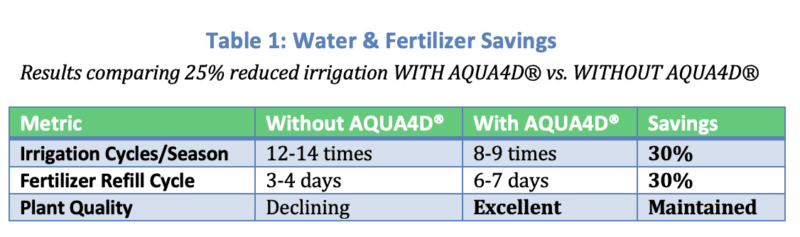
The practical results were substantial: 30% water savings (irrigation frequency reduced from 12-14 applications per season to 8-9 applications) combined with 30% fertilizer savings (refill cycles extended from 3-4 days to 6-7 days). Critically, plant quality remained excellent during peak production season.
What the Numbers Mean
Analysis of the 60 laboratory measurements showed consistent improvements with AQUA4D® treatment under water stress:
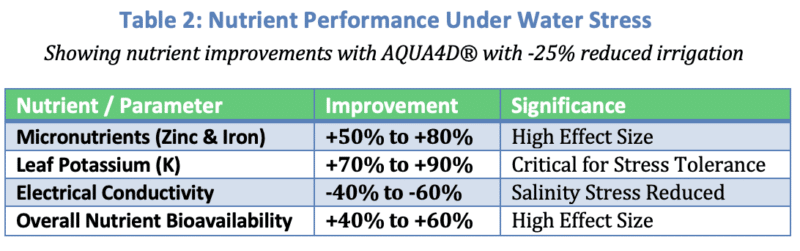
Micronutrient availability (zinc and iron) improved by 50-80% when plants faced the combined stress of hard water and reduced irrigation. Leaf potassium—the “stress nutrient” critical for drought tolerance and plant resilience—showed improvements of 70-90%. Electrical conductivity measurements, a direct indicator of salt stress, decreased by 40-60% despite the extreme hardness of the water source.
These are not marginal improvements. They represent the kind of nutrient and stress management that translates directly into healthier plants and lower input costs.
Why This Trial Matters
The significance of this trial lies not in testing AQUA4D® under ideal conditions, but in proving it works under genuinely difficult circumstances. The water UZBAŞ uses is some of the hardest irrigation water in agricultural production. If the technology succeeds in reducing water use and maintaining plant quality on 43.5°F hard water, growers everywhere with similar or less challenging water sources can have confidence it will work for them.
For Turkish ornamental producers facing hard water and water scarcity pressures—conditions that are increasingly common across the Mediterranean and Middle Eastern regions—this represents field-proven evidence from a real operation operating at genuine scale.
For Turkish Growers
For ornamental nurseries throughout Turkey and the region dealing with hard water and water constraints, this trial provides something increasingly rare: field-validated evidence from a working operation managing the kind of water challenges that typically make production economically difficult.
The solution was ultimately straightforward for UZBAS: physical water treatment with minimal maintenance, no consumables and negligible energy consumption. In regions such as this where water quality is a genuine constraint on viability, such a technology could become existentially important for ongoing operations.
—–
About UZBAŞ Arboretum: UZBAŞ Arboretum is a leading ornamental plant nursery founded in 1996, operating across 200 hectares in Urla, İzmir, Turkey. The facility specializes in Mediterranean palms, tropical and subtropical outdoor plants, and specialty ornamentals, managing over 250,000 palm trees across 52 species. With 1,900 total plant varieties and a 5,000 m² greenhouse operation, UZBAŞ represents state-of-the-art practice in Turkish ornamental production and is a member of the International Palm Association. Since 2023, UZBAŞ has operated with AQUA4D® physical water treatment technology deployed across their entire facility, combining operational expertise with collaborative partnership to optimize performance under the challenging water conditions their region presents.
About the Research: The 2025 trial was designed and conducted collaboratively between UZBAŞ Arboretum and their AQUA4D® supplier. Laboratory analysis was conducted by agriOlaben Laboratory (Turkish Standards Institution certified) across 60 comprehensive soil and leaf analyses measuring nutrient parameters, salinity levels, and water quality metrics. Data analysis employed AI-based methodology to assess practical significance across 10 different ornamental plant species, all using the same 43.5°F hard well water that UZBAŞ operates with daily.
Turkey
Water-Smart Agriculture
Precision Irrigation