


How a Chilean university is transforming sports facility management with water recycling and physical water treatment technology – original version at CNN Chile here.
Soccer fields, paddle courts, tennis courts… these wildly diverse sports surfaces all share something in common: they require significant water to maintain peak performance. Indeed, sports complexes are among the most water-intensive facilities in educational institutions. For Universidad San Sebastian in Chile, daily water consumption reached thousands of liters – a significant operational cost and environmental impact that demanded innovative solutions. With this in mind, they’re now investing in new sustainable systems to maintain operational excellence at its sports facilities for many years ahead.
A Comprehensive Approach to Water Sustainability
“We started last year with a goal of saving 25 to 30%. With all the savings initiatives, as you can see here, the pool represents our largest water use during the year – approximately 30%. So there are several initiatives that will achieve this savings goal and allow us to be sustainable and environmentally friendly,” explains Diego Karmy, Executive Director of Club Deportivo Universidad San Sebastian.
The university sustainability program targets multiple aspects of water use, but the swimming pool emerged as the key opportunity for both conservation and innovation.
Innovation 1: Pool Water Recycling System
Previously, the club used drinking water for maintaining tennis courts and irrigating green spaces. Today, an integrated water recovery system captures and repurposes water that would otherwise be wasted.
Nelson Palma, Head of Infrastructure and Maintenance at the club, explains the pool backwash recovery system: “We capture the water from the pool backwash process through two 5,000-liter tanks to supply the northern area of the facility and the clay tennis courts. The water project we just completed runs from the tanks behind the pool through underground piping to the clay courts.”
This closed-loop system transforms pool maintenance water – formerly discharged as waste – into a valuable irrigation resource. The dual 5,000-liter storage tanks ensure consistent supply while the underground distribution network delivers recovered water efficiently throughout the facility.
Operations that previously relied entirely on potable water now run exclusively on recovered water, eliminating thousands of liters of freshwater consumption from the irrigation budget.
Innovation 2: Physical Water Treatment Technology
Water use in operations like Universidad San Sebastian represents thousands of liters daily – but new technology has managed to dramatically reduce this consumption while improving results.
Felipe Villarino, General Manager of AQUA4D LatAm, describes the comprehensive approach: “With each of our clients, we start by taking a snapshot of their current water management situation, then develop an investment plan where technology becomes one of the possibilities for generating those savings. AQUA4D is a very friendly technology, 100% sustainable, that is installed in current irrigation systems or pump houses. It allows us to have different water – water that hydrates and moistens better – and that translates into several benefits. We are averaging 30 to 40% water savings.”
How the technology works
AQUA4D®, and advances water treatment tech from Switzerland, modifies water physical properties without chemicals or additives. Installed directly on existing irrigation infrastructure, the system:
- – Improves soil penetration: Water infiltrates more effectively, reducing runoff and waste
- – Enhances moisture distribution: Better hydration throughout the root zone with less volume
- – Optimizes nutrient delivery: Fertilizers and soil amendments work more efficiently
- – Prevents scale and biofilm: Protects irrigation infrastructure from mineral buildup
The result is a transformation in both water efficiency and turf performance – not through infrastructure replacement, but through improving how water behaves in soil and plant systems. Additionally knock-on effects include lower energy costs from decreased pumping, improved color and vigor in playing surfaces, and improved turf quality with significantly less water.
Expanding Applications: Residential and Commercial
The same technology proving effective for turf management is available for residential applications. Homeowners and facility managers can across the world use the water treatment to treat limescale, corrosion and biofilm among other things. This has persuaded Comercial Dominguez, a leading water treatment equipment distributor in Chile, to integrate AQUA4D® into its portfolio.
“We are a company that is constantly investigating different products that can serve our very loyal customers. Our clients move houses, buy a second home, and call us to equip their property,” explains Eugenio Dominguez, General Manager.
“It is fundamental that we can recommend to clients the best of what is coming out on the market, and in this case, clearly, for water treatment, AQUA4D is the solution for treating limescale, caring for pipes, and obviously saving on lawn irrigation,” Dominguez adds.
A Model for Educational Institutions
Universidad San Sebastian comprehensive water management program demonstrates how educational institutions can achieve significant sustainability goals through strategic technology adoption.
The Dual-Strategy Success:
- 1. Water Recovery: Capturing and repurposing pool backwash water eliminates waste and reduces potable water demand for irrigation
- 2. Water Optimization: Physical water treatment ensures every liter of water – whether recycled or fresh – performs at maximum efficiency
This combination addresses water challenges from both supply and efficiency perspectives, creating compounding benefits that exceed what either approach could achieve independently.
The Broader Context: Water Challenge in Chile
This transformation in water management efficiency comes at a critical time for Chile and the broader Latin American region. Water scarcity, intensified by climate change and increasing demand, has made conservation essential rather than optional.
Physical water transformation technology allows facilities to do more with existing water resources – a necessity in a global context marked by drought and the imperative to optimize natural resources.
For universities, sports facilities, and commercial operations throughout water-stressed regions, the Universidad San Sebastian model offers a proven pathway: combine smart water recovery with advanced treatment technology to achieve dramatic efficiency gains without compromising performance.
Chile
Turf Irrigation
Sports Fields
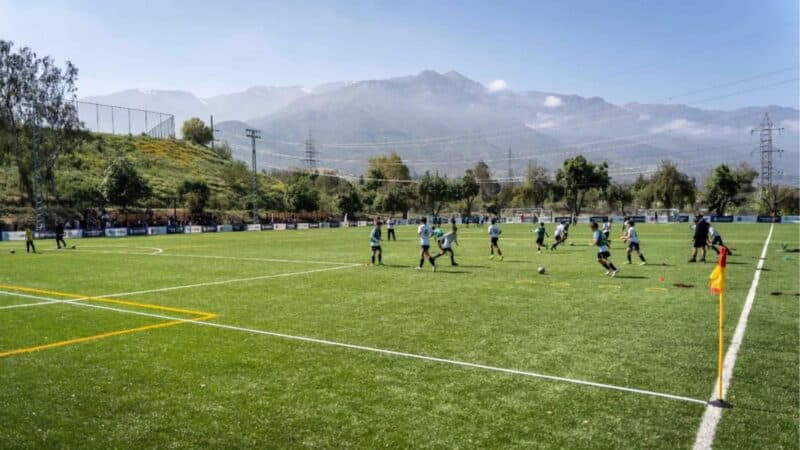
“We started last year with a goal of saving 25 to 30%. With all the savings initiatives, as you can see here, the pool represents our largest water use during the year – approximately 30%. So there are several initiatives that will achieve this savings goal and allow us to be sustainable and environmentally friendly,”
– Diego Karmy, Executive Director of Club Deportivo Universidad San Sebastian.
Watch the CNN Chile feature on this landmark integrated water efficiency project